
A Conversation Worth Starting
This is the final piece in a five-part series and I consider it an invitation.
The organizations reading this have already navigated the previous four — where I documented funding disruption, policy shifts, and the structural fragility that comes with building on a foundation designed for dependency. The question this piece raises is not what went wrong. That has been well documented. It wasn't you.
The question is what comes next. Specifically: what does a financially sovereign, mission-driven organization actually look like? And is it possible to build one?
The answer is yes. But it requires a different conversation than the one we've all been having.
The Model That Got Us Here
The dominant funding model for nonprofits was never designed for sustainability. It was designed for service delivery — to channel public and philanthropic dollars toward community need through tax-exempt organizations, measure outputs, report, and repeat.
While that model has produced real community value, it also created structural dependency. Organizations built entirely around grant funding have, by design, limited control over their own financial health. When the funding environment shifts — and it always shifts — they have no buffer, no alternative channel, and no internal engine generating revenue independently.
The Nonprofit Finance Fund found that 52% of nonprofits have three months or less of cash on hand. While it might appear to be a management failure, it is actually a predictable outcome of a model that was never structured to build reserves, diversify revenue, or generate financial independence.
What if the grant wasn't the goal? What if the grant was just one of many tools?
What Financial Sovereignty Looks Like
Financial sovereignty means having enough control over your own revenue that no single funder, policy change, or external disruption can threaten your ability to continue the work. It means having multiple streams of income — and many individual households and for-profit businesses have been leveraging this same principle as they navigate choppy economic waters.
It does not mean rejecting grants or government funding. It means not depending on them exclusively.
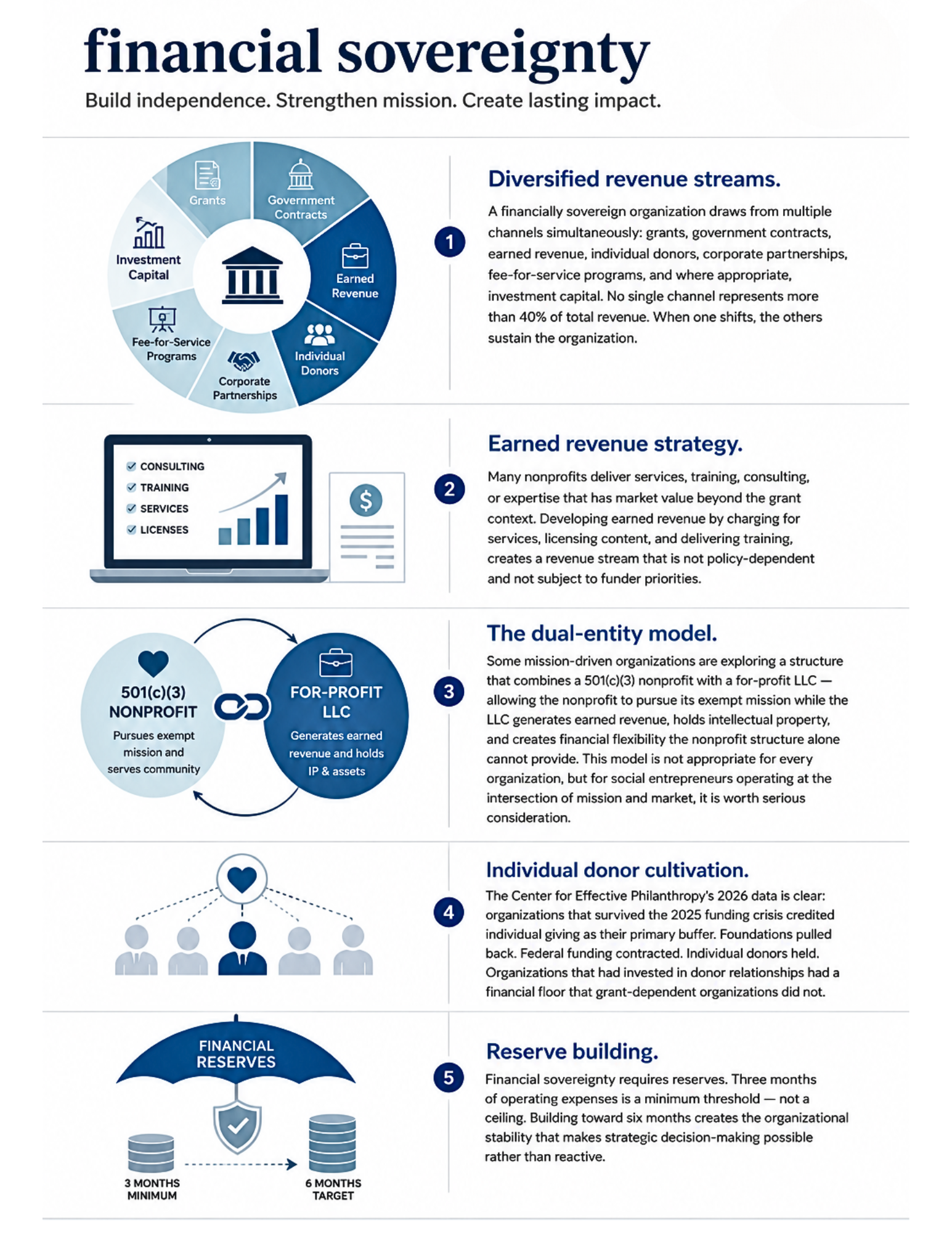
Here is what financial sovereignty looks like in practice:
Diversified Revenue Streams
A financially sovereign organization draws from multiple channels simultaneously: grants, government contracts, earned revenue, individual donors, corporate partnerships, fee-for-service programs, and where appropriate, investment capital. No single channel represents more than 40% of total revenue. When one shifts, the others sustain the organization.
Earned Revenue Strategy
Many nonprofits deliver services, training, consulting, or expertise that has market value beyond the grant context. Developing earned revenue by charging for services, licensing content, and delivering training creates a revenue stream that is not policy-dependent and not subject to funder priorities.
The Dual-Entity Model
Some mission-driven organizations are exploring a structure that combines a 501(c)(3) nonprofit with a for-profit LLC — allowing the nonprofit to pursue its exempt mission while the LLC generates earned revenue, holds intellectual property, and creates financial flexibility the nonprofit structure alone cannot provide. This model is not appropriate for every organization, but for social entrepreneurs operating at the intersection of mission and market, it is worth serious consideration.
Individual Donor Cultivation
The Center for Effective Philanthropy's 2026 data is clear: organizations that survived the 2025 funding crisis credited individual giving as their primary buffer. Foundations pulled back. Federal funding contracted. Individual donors held. Organizations that had invested in donor relationships had a financial floor that grant-dependent organizations did not.
Reserve Building
Financial sovereignty requires reserves. Three months of operating expenses is a minimum threshold — not a ceiling. Building toward six months creates the organizational stability that makes strategic decision-making possible rather than reactive.
The Social Enterprise Model
Social enterprise sits at the intersection of mission and market. A social enterprise generates revenue through its core activities as the primary business model, while directing that revenue toward community benefit. This model isn't new — but it's becoming newly urgent.
Organizations that operate staffing agencies alongside their training programs
Nonprofits that run catering businesses and redirect surplus to community programs
Organizations that develop and manage property, generating revenue to fund mission
Organizations that charge market rates for professional development and subsidize community cohorts with the surplus
The key distinction: a social enterprise is not a nonprofit that sells things on the side. It is an organization that has built a business model around its mission — where the commercial activity and the community benefit are the same activity, not separate ones.
What Is Holding Organizations Back
The most common barriers to financial diversification are structural and practical — and all of them can be addressed through deliberate organizational infrastructure building.
The Infrastructure Connection
Here is where this conversation connects directly to everything FundReady builds:
Financial sovereignty is not possible without organizational infrastructure. The governance systems, financial documentation, strategic planning frameworks, and capital strategy tools that FundReady helps organizations build are not just grant readiness tools. They are the foundation for any revenue model — diversified, earned, or otherwise.
An organization with a strong mission and vision, documented theory of change, logic models, process maps, measurement and evaluation tools, financial systems that demonstrate accountability, strategic plans, and a multi-channel capital strategy — is an organization positioned to pursue earned revenue, attract individual donors, explore dual-entity structures, and make strategic decisions from a well-grounded center rather than urgency.
The infrastructure comes first. The new economic model is built on top of it.
Questions Worth Sitting With
This series is intended to be a conversation starter. Here are the questions worth bringing to your leadership team, your board, and your strategic planning process:
What percentage of our revenue comes from a single source or funding type? What is our concentration risk?
What services, expertise, or content does our organization produce that has value beyond the grant context?
Are there communities or organizations that would pay for what we currently provide for free — and would charging for it compromise our mission, or expand our reach?
What would our organization look like in five years if we were not dependent on any single funder?
What structural options — earned revenue, dual-entity, social enterprise, individual donor cultivation — are worth exploring for our specific mission and market context?
What organizational infrastructure do we need to build before any of these models becomes viable?
There are no universal answers. Every organization's path to financial sovereignty is shaped by its mission, its community, its market context, and its current infrastructure. What is universal is the need to start asking the questions — and taking action toward building the internal capacity to act on the answers. It's never too late nor too early to start.
Before any new model is viable, the foundation has to be in place.
FundReady's free assessments give you a documented baseline across every domain of organizational readiness — the starting point for any strategic conversation about financial diversification.
Sources
- Center for Effective Philanthropy, State of Nonprofits 2026: What Funders Need to Know (May 2026)
- Nonprofit Finance Fund, 2025 State of the Nonprofit Sector Survey
- National Council of Nonprofits, Earned Income and Social Enterprise (2024)
- Stanford Social Innovation Review, The Case for Social Enterprise (2024)
- IRS Publication 598, Tax on Unrelated Business Income of Exempt Organizations
- Candid, Nonprofits Face Financial Instability (May 2026)
The Shift Is Here: Federal Funding, Project 2025, and What to Build Next
Read + Download →The Grant Research Trap: Why More Applications Are Making the Problem Worse
Read + Download →Capital Strategies: What Every Nonprofit Leader and Small Business Owner Needs to Know
Read + Download →How Did We Get Here? The Infrastructure Was Never Built — and You Were Never Given a Blueprint
Read + Download →Beyond the Grant: Building a New Economic Model for Mission-Driven Organizations
Current reportThe new model starts with knowing where you are.
Take the free FundReady Grant Readiness Assessment — 62 points, six domains, ten minutes.